Who we are
CRISPRkit was invented by undergraduate students Matthew Lau and Marvin Collins at Stanford University in Stanley Qi‘s laboratory.
The inspiration for CRISPRkit came from a profound realization of the transformative potential of CRISPR-Cas technology. Regarded as a monumental breakthrough in modern biology, CRISPR gene editing has revolutionized biotechnology, enabling groundbreaking treatments for diseases such as cancer.
Just as computer programming – another driving force for innovation – the push to promote equity and make computer science accessible for young learners has accelerated advancements in the field. We firmly believe that, just as computer programming has found its place in schools, gene editing should be introduced and made accessible for young learners to explore.
However, traditional gene editing experiments remain largely inaccessible due to cost, complexity, and perceived risks. Often, only graduate or PhD students get the opportunity to engage hands-on with these experiments. To truly democratize this technology, there is a need to devise an affordable, groundbreaking solution.
Our Solution
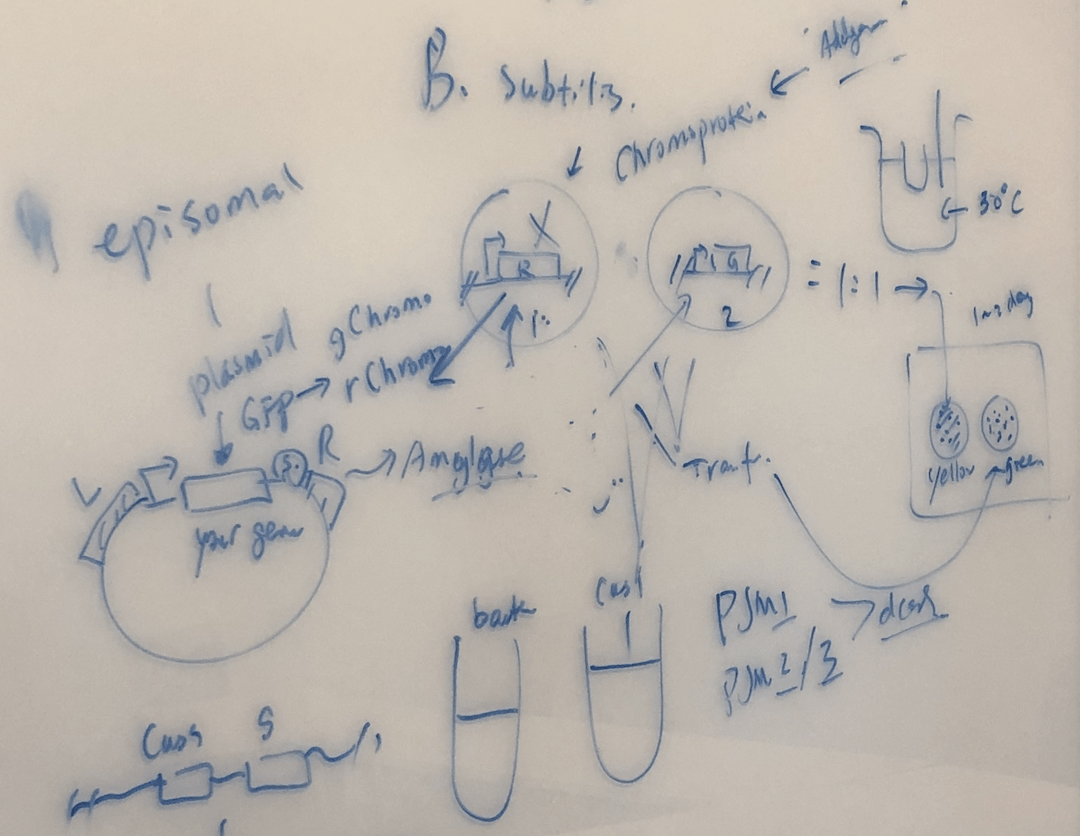
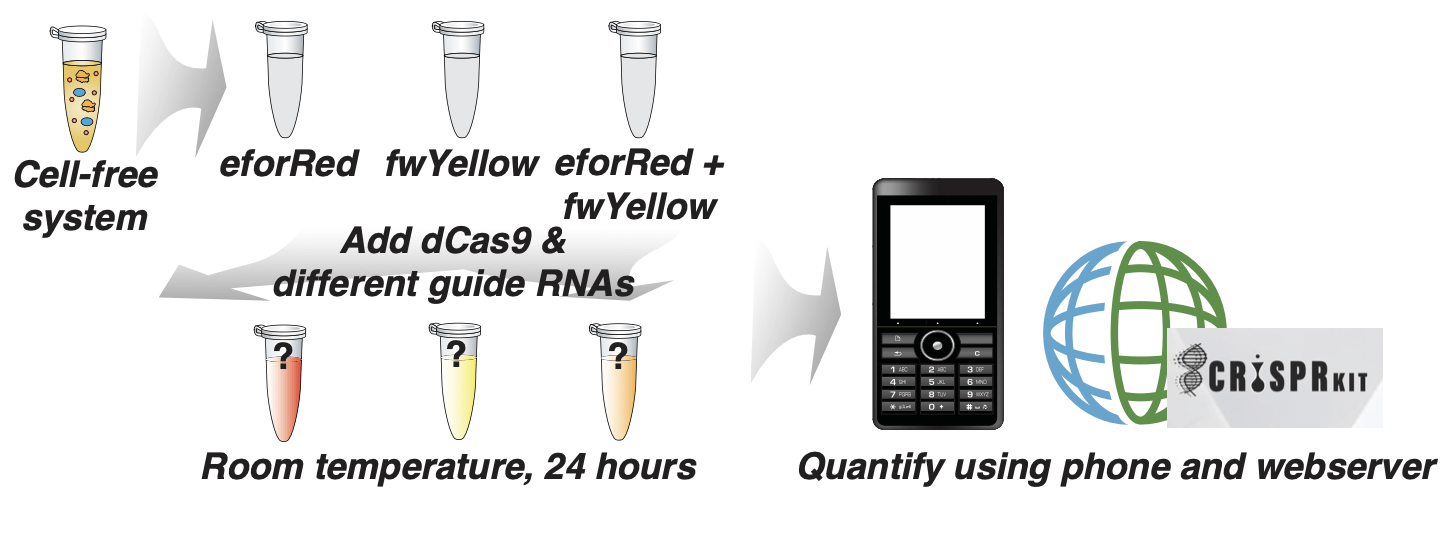
Our solution tackles a key challenge in traditional CRISPR experiments: the necessity for live cell cultures. By leveraging a cell-free transcription-translation (TXTL) system, we have crafted an in vitro environment optimal for CRISPR gene editing and regulation experiments. With the TXTL system, one can complete an experiment by simply combining various CRISPR components in a tube, eliminating many steps typical of conventional experiments.
Another hurdle has been experimental readouts and analysis. Traditional CRISPR gene knockouts and knockdowns often require quantification using costly equipment found only in labs. Our solution? We employ chromoproteins that produce vivid pigments easily seen by the naked eye. Furthermore, we have developed a novel computational algorithm CRISPectra capable of analyzing smartphone-captured images of these results, removing the need for specialized equipment.
Revolutionizing CRISPR & Biology

Lowering Cost
Unlike traditional CRISPR experiments which cost thousands of dollars, our kits are approximately less than $5 each. We bypass the need for expensive lab equipment, making gene editing achievable anywhere, anytime.
Saving Time & Simplifying Steps
While conventional CRISPR experiments take days and involve complex steps, our streamlined protocol requires only 20 minutes lab work and delivers results from 4-24 hours, making gene editing quick and easy.

Bridging Concept & Implementation
Biology education often suffers from a disconnect between theory and practical application. Our kits offer hands-on experience with CRISPR, facilitating a deeper understanding of the technology and its real-world application.

Education
We believe that equipping the next generation of scientists with the tools of gene editing is critical. By supplying schools with our kits and helping them incorporate CRIPSR into curriculums, we aim to democratize gene editing and inspire future pioneers in genetic engineering.
2019
CRISPRkit idea conception
2020 - 2021
COVID-19 disrupted operations
Early 2022
Developed first prototype: single color experiment
Mid 2022
Developed dual color kit
April 2023
Tested kits with Stanford undergraduate students
May 2023
Received requests from 30+ schools in the Bay Area
October 2023
First high school test with Los Altos High School
May 2024
Expanded kit offerings, including development of melanin kit
August 2024
CRISPRkit paper published on Nature Communications
September 2024 -
Pilot program launch, with kits served to 20 schools